| |
Mechanical
Mechanical clearance assets are an essential aid to most mine clearance
projects and the programme in South Lebanon is no exception. A variety
of machines are currently deployed within the MACC SL theatre of
operations and although they aren’t necessarily a solution
to every scenario, the assets used have been found to be generally
effective.
The Threat
By far the main threat found in the project area is the Israeli
No 4 and No 4A Anti-Personnel mine. These mines have in general
been laid in ‘military pattern” rows and the Clearance
Methodology developed for OES reflects this. They are laid in
large quantities, employ a cocked striker mechanism and have proved
difficult to clear with a mechanical flail.
At the beginning of the project mechanical flails were permitted
as a primary clearance asset against these mines on a site specific
basis. However, it very soon became apparent this was not effective
and essentially created more problems than it solved. After flailing
had taken place it was noted that mines were missed, disturbed,
sensitised and broken up with detonators and explosive fill spread
throughout. Mine Detection Dog (MDD) confirmation proved difficult
if not impossible due the increased explosive residue and manual
follow up proved even more dangerous due to mines having partially
functioned or having been moved out of position.
As a result of this it was decided that mechanical assets would
not be used as a primary mine clearance tool in any minefield
or High Threat Hazardous Area (HTHA) containing mines fitted with
a cocked striker.
Although no single mechanical asset solves all the mine / UXO
threat problems, with good preparation and planning between all
the assets in the clearance “Toolbox”, most areas
can be effectively and safely cleared to international standards.
Cooperation between all the agencies and contractors is also of
paramount importance to achieve the set goals and targets, which
is to return safe ground to the local population that they are
confident to use.
The following equipments are accredited by the MACC SL to work
within the Operation Emirates Solidarity theatre of operations.
ARMTRAC 100 Mechanical
Flail
ARMTRAC 325 Mechanical Flail
Bozena 3 Mechanical Flail
Armoured Excavators, Strimmers
and Sifters
Armoured Dozer
|
|
|
ARMTRAC
100 Mechanical Flail
|
|
| |
|
|
|
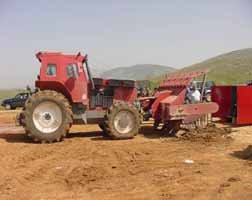
Both BACTEC International Limited,
and MineTech when they were contracted with the OES project deployed
this model of flail to assist them with their work. It is an armoured
flail machine designed around an agricultural tractor chassis and
is a well known mechanical asset within the demining world. When
flailing, the machine utilizes a creep drive motor, which ensures
a clearance rate of up to 1600 m² per hour depending on the
terrain. The width of the cut given from the flail is 2.2 metres
and a depth of 20 centimetres is achievable. The flail rotors are
expected to withstand the blast from both anti-personnel and anti-tank
mines.
Within the MACC SL theatre, the ARMTRAC 100 is accredited to
operate independently providing it has close support from a manual
clearance asset and a Medic and ambulance. The ancillary equipment
items are easily transported in a large stowage bin mounted on
the rear of the tractor therefore the whole team is able to deploy
rapidly and travel fairly quickly from site to site. It as been
deployed within South Lebanon since May 2002 and has proved its
durability time and again in an array of tough situations. As
with other flail machines it does have limited capabilities in
heavy rock and boulder-strewn areas, and this is a deciding factor
when considering where to deploy it. However to aid the ARMTRAC
100 in such difficult areas an Armoured Bulldozer can be utilized
to move large obstacles.
Typical ARMTRAC 100 Team composition
Operating independently, a typical team consists of:
ARMTRAC 100 & tool stowage bin
Ambulance
Support vehicle
Mechanical Supervisor
Operator / Mechanic
2 X Deminers accredited as Mechanical support personnel
1 x Medic
2 x Drivers
Accreditation
The ARMTRAC 100 has been trialled in country and has been accredited
to achieve a 20cm cut depth in the harsh ground conditions of
South Lebanon. As a result of this trial the equipment is accredited
to conduct tasks as indicated in the table below. Note there is
no accreditation for using this asset as a primary clearance tool.
|
|
| |
Task |
Depth |
Yes |
No
|
| Primary clearance of MFAC |
20 cm |
- |
X |
| Primary clearance of HTHA |
20 cm |
- |
X |
| Clearance of LTHA |
10 cm |
X |
- |
| Verification of suspect areas |
20 cm |
X |
- |
| Confirmation of MFAC |
20 cm |
X |
- |
| Confirmation of HTHA |
20 cm |
X |
- |
| Ground Preparation of HTHA |
NA |
X |
- |
| Ground Preparation of LTHA |
NA |
X |
- |
| Survey and Area Reduction |
20 cm |
X |
- |
|
|
|
For more information on this
equipment visit the manufacturer’s website at http://gscs.sagenet.co.uk
|
|
| |
ARMTRAC
325 Mechanical Flail
|
|
|
|
|
| |
The ARMTRAC 325 was initially used in the OES project by MineTech
International, to assist them with their Phase 2 contract.
Nicknamed “The Beast”, the ARMTRAC 325 is a large armoured
flail machine which is a well known mechanical asset within the
demining world. When flailing, the machine utilizes a 16-speed gearbox,
which ensures a slow clearance speed. The width of the cut is 2.2m,
and a depth of 20cm is achievable. The flail rotors are marketed
as being able to withstand blasts caused by encounters with both
anti-personnel and anti-tank mines.
Within the MACC SL theatre, the ARMTRAC 325 is accredited to operate
independently providing that it has close support from a manual
clearance asset with a Medic and ambulance. The ancillaries are
transported on a large trailer that is towed by the main equipment,
making it possible for the team to deploy quickly. However road
travel is slow due to the size of the machine. It is best suited
therefore on large open areas. As with other flail machines it does
have limited capabilities in heavy rock and boulder-strewn areas,
and this is a deciding factor when considering where it is to be
deployed. To aid the ARMTRAC 325 in such difficult areas an Armoured
Bulldozer can be utilized to move large obstacles.
Typical
ARMTRAC 325 Team composition Operating independently,
a typical team consists of:
ARMTRAC 325, Trailer and Ancillaries
Ambulance
Support vehicle
1 x Mechanical Team Supervisor
1 x Operator / Mechanic
2 x Deminers accredited as Mechanical Support personnel
1 x Medic
2 x Drivers
Accreditation
The ARMTRAC 325 has been trialled in country and has been accredited
to achieve a 20cm cut depth in the harsh ground conditions of
South Lebanon. The table below outlines those tasks that the machine
is accredited to do in South Lebanon, along with those it is not
permitted to conduct.
|
|
| |
Task |
Depth |
Yes |
No
|
| Primary clearance of MFAC |
20 cm |
- |
X |
| Primary clearance of HTHA |
20 cm |
- |
X |
| Clearance of LTHA |
10 cm |
X |
- |
| Verification of suspect areas |
20 cm |
X |
- |
| Confirmation of MFAC and HTHA |
20 cm |
X |
- |
| Ground Preparation of HTHA |
NA |
- |
X |
| Ground Preparation of LTHA |
NA |
- |
X |
| Survey and Area Reduction |
20 cm |
X |
- |
|
|
| |
For more information on this equipment visit the manufacturer’s
website at http://www.gscs.sagenet.co.uk
|
|
| |
|
|
| |
Bozena
3 Mechanical Flail System
|
|
| |
|
|
| |
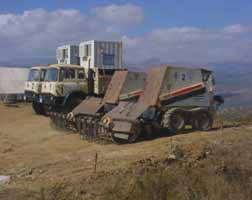
The Bozena 3 Mini Flail System is a mechanical asset that is designed
and manufactured by WAY
INDUSTRY of Slovakia. It is already in use with many de-mining
agencies around the world and BACTEC International Limited operates
four machines in South Lebanon.
The equipment is a radio controlled tracked mini flail that is
operated remotely from a separate armoured cabin. As an alternative
to this there is a facility that allows the operator to dismount
from the cabin and control the machine on foot from a safe position.
It is transported on a 4 wheeled trailer towed by a 3 ton truck
which also carries the armoured cabin and ancillary equipment.
The fact that Bozena 3 and its entire support element can be
rapidly vehicle-loaded and ready for transportation along with
a dedicated crew, and the low machine “down time”
makes it a versatile and cost effective asset.
Although versatile, it does have limited capabilities in heavy
rock and boulder strewn areas, and this is a deciding factor when
considering where to deploy it. However to aid the equipment in
such difficult areas an Armoured Bulldozer can be utilized to
move large obstacles.
Typical Bozena 3 Mechanical Team composition
Operating independently, a typical team consists of:
Bozena 3 Flail
Support vehicle and trailer carrying, armoured cabin and ancillaries
Ambulance
1 x Mechanical Supervisor
1 x Operator / Mechanic
2 x Deminers accredited as Mechanical support personnel
1 x Medic
2 x Drivers
Accreditation
The Bozena 3 has been trialled in country and has been accredited
to achieve a 10cm cut depth in the harsh ground conditions of
South Lebanon. As a result of this the equipment is accredited
only to conduct the Tasks indicated as “Yes” in the
table below.
|
|
| |
Task |
Depth |
Yes |
No
|
| Primary clearance of MFAC |
20 cm |
- |
X |
| Primary clearance of HTHA |
20 cm |
- |
X |
| Clearance of LTHA |
10 cm |
X |
- |
| Verification of suspect areas |
20 cm |
- |
X |
| Confirmation of MFAC |
20 cm |
- |
X |
| Confirmation of HTHA |
20 cm |
- |
X |
| Ground Preparation of HTHA |
NA |
X |
- |
| Ground Preparation of LTHA |
NA |
X |
- |
| Survey and Area Reduction |
20 cm |
- |
X |
|
|
| |
|
|
| |
|
|
| |
|
|
| |
Armoured
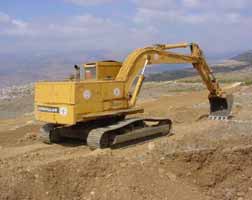
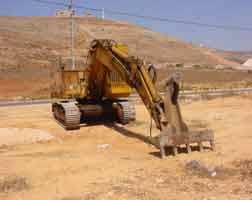
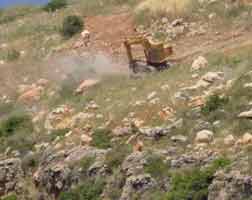
Excavators The Armoured Excavators employed, are “off
the shelf” Caterpillar 215 and 225 tracked excavators that
have been “beefed” up by the addition of enhanced
protection for the equipment operator. They are not a mine clearance
tool and are not allowed to work inside the High Threat Hazardous
Area (HTHA). Deployment of the excavators within the MACC SL theatre
is carefully monitored by both the MACC SL and by the clearance
contractor. They are essentially used in a “ground preparation”
role as they would on many construction sites; digging trenches,
removing obstacles, dismantling bunds, spreading soil and cutting
tracks. The advantage of being “tracked’ is that they
can gain access to almost any area regardless of the terrain and
topography whilst maintaining a relatively low ground bearing
pressure.
|
|
| |
|
|
| |
Armoured Strimmer
|
|
| |
|
|
|
| |
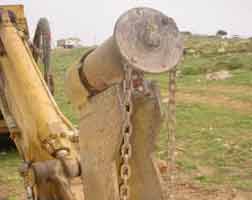
The Armoured Strimmer is a tracked
excavator with the bucket removed and a strimmer head attached in
its place. This consists of a hydraulic rotary motor and chain assembly
that is powered by the main equipments’ hydraulic system.
It is considered a very useful and cost effective alternative to
manual assets spending time cutting high, thick or thorny vegetation
in rough areas. It can dramatically reduce the overall clearance
times by enabling the de-miner to concentrate on mine clearance
without having to conduct dense vegetation removal drills. A “drag
toothed” bucket (see photograph above) is also incorporated
into the strimmer head. This allows the operator to drag and remove
barbed wire obstacles such as minefield fencing.
Essentially the strimmer is a horizontal flail with cutting chains
that rotate at high speed. Therefore safety distances must be
maintained and this may limit the use of other assets working
on the same task.
In addition to this a primary factor, prior to the strimmers’
deployment, must be the thorough briefing of the operator as to
his tasking. Ideally, ground penetration should be avoided during
strimming operations because it may affect the follow up work
by manual and MDD assets. e.g. excessive ground disturbance may
well put back MDD follow up work by two to seven days, thereby
delaying the continuance of work on the task.
|
|
| |
|
|
|
| |
|
|
|
| |
Sifters (Bucket and Table)
Sifting systems aren’t unique to the MACC SL
theatre however they have become a valuable and very cost effective
method of clearing soil heaps, bunds and areas identified as containing
deep buried mines etc. The two systems in use within MACC SL were
designed in country and fabricated in workshops using local materials.
These systems are currently accredited to sift anti-personnel
mines. They are relatively easy to produce and maintain and are
deployed fairly rapidly from the primary motive unit.
|
|
| |
|
|
| |
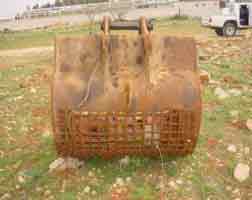
The “Bucket Sifter”
is a ditching bucket (an excavating bucket with holes in it) mounted
on the arm of an Armoured Excavator. The holes are designed smaller
than the smallest mine in country so there is no possibility of
any falling through. Before the task takes place a cleared area
is prepared immediately adjacent to the task. The sifter takes small
bites out of the target and the Operator shakes the bucket over
the prepared area. |
 |
|
| |
Rocks, large stones and mines remain
behind in the bucket, which is closely observed by the Operator.
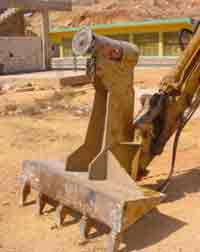
When a suspect item is seen, a trained de-miner is called forward
to remove it using an extended mechanical claw (see last photo below)
and place it in a prepared demolition pit nearby. If no suspect
items are seen in the bucket then he simply continues his excavation
drill.
The bucket generally absorbs the blast from any detonation that
occurs with the Operator protected in his cab. The time saved
by using this method on these difficult areas has greatly increased
productivity. The system has also proved far safer to employ than
attempting to manually clear these areas. The equipments mobility
has enabled the bucket sifter to be deployed almost anywhere in
this theatre of operation.
|
|
| |
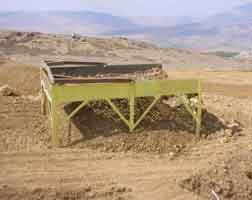
The “Table Sifter” system
Again, designed from local materials and fabricated locally, it
is a simple system utilising a Caterpillar 215/225 Armoured Excavator
and a grilled heavy-duty metal table. Site preparation is as for
the bucket sifter and the excavator digs a bucket of earth then
allows the contents to fall (gravity fed) through the grill onto
the ground below. If a suspect item is left behind on the grill
surface then a trained de-miner is called forward to safely remove
it with the mechanical claw and place it in a prepared demolition
area nearby. The table itself is constructed from 6mm steel and
requires little or no maintenance. A lift arm sling incorporated
with the table allows the operator to lift it clear of the developing
mound of soil and move it to another position. The earth that falls
through the table grill is spread out (not greater than 200mm) and
is then re-checked by another asset.
Although no exact details of the rate of area sifted is currently
available, a “rule of thumb” is approximately 1 tonne
per every 15 minutes, allowing for the hardness of the mound(s)
and the amount of items that require removal from the table grill.
|
|
| |
 Photograph of table sifter conducting non-operational tests
|
|
| |
As stated, all systems have limitations and the main disadvantages
of the sifting systems are the weather and ground conditions. In
wet ground conditions it can be near impossible to sift the lumps
of earth that are excavated, therefore this equipment cannot generally
be used in the winter and rainy seasons. Conversely in the harsh
dry summer months the ground can be baked hard and can cause problems
when sifting. Additional water can be used to wash the soil through
the grill however this quickly reduces the area into a quagmire
and usually compounds any existing problems.
|
|
| |
|
|
|
| |
|
|
|
| |
|
|
|
| |
Mechanical “Claw”
The “Claw” is simply a modified rubbish collector which
is used by a mechanical support deminer to move a live mine / UXO.
It is only deployed in conjunction with sifting operations and allows
the safe movement of suspect items to a demolition area. The claw
itself is easy to use, however part of the removal drill requires
an assessment of the item being picked up to ensure that it is safe
to move. Therefore only trained personnel wearing full PPE are permitted
to use it.
|
|
| |
|
|
| |
Within the MACC SL theatre, the tracked
Excavators, Strimmers and Sifters are accredited to operate independently
providing that they have close support from a manual clearance asset,
medic and an ambulance. These equipments are also generally used
in conjunction with an Armoured Bulldozer, which can be utilized
to move sifted soil and large obstacles. |
|
| |
Typical team make up
Operating independently, a typical team consists of:
Main tracked equipment 215/225 Caterpillar
Ambulance
Support vehicle
Mechanical Supervisor
Operator / Mechanic
Mechanical accredited deminers x 2
Medic
Driver x 2
Low loader (hired locally on an as required basis)
Accreditation
Within the OES project, Excavators, Strimmers and Sifters are
accredited as clearance tools for the clearance of contaminated
earth spoil containing anti-personnel mines only. They can
also be used as a clearance tool to clear deep buried AP mines
on a site-by-site basis.
They are not used for excavating or sifting AT mines or UXO.
|
|
| |
Task |
Depth |
Yes |
No |
| Clearing access tracks |
NA |
X |
- |
| Clearing wire and fencing |
NA |
X |
- |
| Clearing debris, earth, tree stumps, etc |
NA |
X |
- |
| Sifting of contaminated bunds & embankments containing
AP mines |
NA |
X |
- |
| Sifting of contaminated bunds & embankments
containing AT mines and UXO |
NA |
- |
X |
| Confirmation clearance after main clearance asset |
20 cm |
- |
X |
| Primary Clearance of known mines rows at normal depth |
20 cm |
- |
X |
| Verification |
20 cm |
- |
X |
| Ground Preparation of HTHA |
NA |
X |
- |
| Ground Preparation of LTHA |
NA |
X |
- |
| Survey and Area Reduction |
20 cm |
- |
X |
|
|
| |
For more information about
Caterpillar equipment visit http://www.cat.com
|
|
| |
Armoured
Bulldozer
|
|
| |
|
|
| |
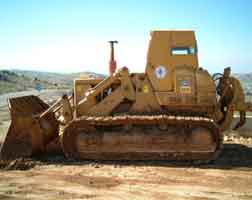
Armoured Bulldozers are used in the
MACC SL theatre in a site preparation role, dozing access tracks
through difficult areas to enable other mechanical assets, MDD and
manual demining teams to gain easier access to the work area.
Basically this is an “off the shelf’’ commercial
bulldozer which has been modified by adding armoured protection
in particular to the cabin area which is necessary to protect
the driver/operator. Those in operation in South Lebanon within
the OES project are based on the Caterpillar 977L crawler tractor
/ loader.
The bulldozers are also deployed to spread out soil heaps and
bunds etc in preparation for clearance by MDD or other mechanical
assets, for example the ARMTRAC or the Bozena 3 flails. The bulldozers
adhere to SOP’s and TSG’s as do all other mechanical
assets. They have their own dedicated support team who are experienced
deminers accredited for their role. They perform, as with all
mechanical assets, visible checks of the machine when it is leaving
a hazardous area, and before moving to a low threat area.
Although a durable piece of equipment; ground conditions are
a main concern when thinking of deploying the bulldozer, and in
fact all plant machinery. If deployed upon a steep incline in
wet (or snow covered) ground a bulldozer may have a tendency to
slide sideways down the hill, and with the weight of the machine
it will be impossible to stop and possibly recover. In addition
care must be taken that the operator doesn’t bulldoze mines
away with the spoil when making access routes as this could further
complicate clearance of the area.
Accreditation
Within the OES project, bulldozers are not accredited as a clearance
tool.
However it is the MACC SL intention to accredit the machine in
the future for moving of contaminated spoils to assist with sifting/crushing
operations
Below, is a table outlining the mine action functions the armoured
bulldozers have been accredited for within the OES Project. The
‘No’ column are tasks they are not permitted to conduct.
|
|
| |
Task |
Depth |
Yes |
No |
| Clearing access tracks |
NA |
X |
- |
| Clearing wire and fencing |
NA |
X |
- |
| Clearing debris, earth, tree stumps, etc |
NA |
X |
- |
| Aid the sifter in bund clearance |
NA |
X |
- |
| Confirmation after main clearance asset |
20 cm |
- |
X |
| Primary Clearance |
20 cm |
- |
X |
| Verification |
20 cm |
- |
X |
| Ground Preparation of LTHA |
NA |
- |
X |
| Survey and Area Reduction |
20 cm |
- |
X |
|
|
| |
|
|
|
|
|
| |
|
|
| |
|
|
| |
Copyright ©2004
MACC SL - All Rights Reserved |
|