Manual

Overview

Ever since the concept of physical de-mining began the primary clearance method has been focused on manual de-mining and the techniques associated with it. In recent history scenes of individuals clearing fields or suspect areas by prodding with drawn bayonets has given way to more specialized personal equipment and in some cases personalised or adapted equipment designed to reduce the injuries to the de-miner and make the clearance method safer and more effective.

Although there are now a variety of clearance methods in the de-mining “Toolbox” no one method currently manages to address all the situations that can arise.
Adverse weather has a detrimental effect on clearance by animals, humans and machines; terrain, topography, rocky ground and vegetation can also affect all the clearance assets in different ways. Tiredness and poor training can hinder any clearance involving human intervention.
Research into alternate methods as diverse as infrared technology, odour detectors through to trained rats all pose as possible inroads to speed up the process of mine removal. However, the manual deminer equipped with a detector is without a doubt the most efficient and effective asset in dealing with the threat within the OES project area.

At some stage of most mine clearance tasks, even those involving remote mechanical clearance, there will be a person with a detector or a prodder or both somewhere in the clearance equation, even if it is just in a QA role. Once the human element is introduced then the risk factor to human safety is substantially increased. It is particularly at this juncture that all and every effort is made to protect the de-miner and to minimise the risk(s) to the individual concerned.

Manual De-Mining within OES

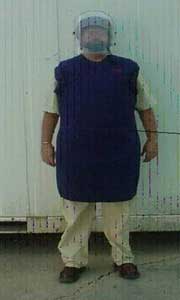
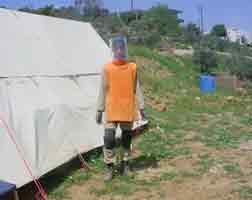
All deminers working in the OES project wear an Apron and Visor as minimum standard protective personal equipment (PPE). In addition one of the OES contractors insists that the de-miner wears safety goggles under the visor while working in the minefield. Also in theatre de-miners wear kneepads, and on occasion elbow pads and Kevlar gloves. Not all these measures are to protect the de-miner from blast injuries; some are for protection against sharp vegetation, rocks and hard ground in the minefield.

As with all de-mining tasks, the most important aspect of the project is the actual physical clearance. This has to be done both safely and effectively. While the emphasis and responsibility placed upon every de-miner varies from site to site, the success of a project lies ultimately with him/her. Within the minefield a variety of systems are put in place to assist and ensure that targets can be met and safety reinforced at every level and stage of the operation. These are laid down in the organisations SOP and adherence is monitored by the Team Leaders, Supervisors and internal Quality Assurance mechanism’s to ensure these procedures are implemented as defined.
In addition to well maintained equipment the MCT is supported with Medics and adequately equipped ambulances, trained drivers and good communication systems to support their team colleagues.

All of the above factors are obviously important, however without correct and thorough training in all aspects of the de-miners role and responsibilities then problems will invariably occur in the field. Correct and thorough training is the responsibility of the clearance organisation and confirmation of this is sought through the accreditation process.

The UN has a responsibility to the UAE government to ensure that the project achievements are effective and as efficient as possible. In this regard, the MACC SL has an external system of Quality Assurance in place to ensure that in addition to the company’s SOP, the mine clearance contractors are also adhering to the country specific National Technical Standards and Guidelines (TSG)’s drawn from the International Mine Action Standards (IMAS).

Prior to any demining operations beginning on the ground a “chain” of events and key personnel exists in various positions with various agencies all interacting to ensure that the de-miner is supported to the best standard possible. All these systems are designed to make the de-mining environment safer, if not the actual act of demining.

One key support to the Manual Clearance Team (MCT) is a detailed Task Dossier the mine clearance organisation receives for each Task Site from the MACC SL. See Example Task Dossier.

To further assist in making the information contained in the Task Dossier more reliable the MACC SL has their own Community Liaison Team whose role it is to enhance the reliability of information passed by the community through to the MACC SL about further suspected or Dangerous Areas.
Only after an exhaustive system of General and Technical Survey is conducted and a risk assessment made will an asset by deployed into an area to conduct clearance.


Manual Demining Equipment Used in the OES Project

Metal Detectors (CEIA, Minelab, Ebinger)


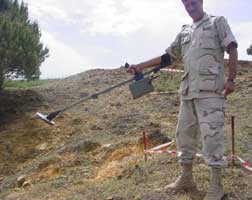
As with most aspects of the de-mining industry over the last ten to fifteen years, there has been something of a flood of equipment geared or designed for the de-miner, or at least claimed to have been designed with the de-miners safety as paramount. Essentially the detector has become synonymous with de-mining and is possibly one of the most recognizable pieces of equipment in the world today.It would be blasé to state that the detector is simply a glorified metal detector, however they can be. Developments in vapour and chemical detectors as well as advances in infra-red technology are making inroads into assisting the de-miner in the field. However at the present time, primarily for reasons of reliability, the standard metal detector will continue to be the primary detector in use.

Within the OES project two detectors are accredited for use; the MINELAB A1 being the contractor’s primary detecting tool in the field, and the CEIA, which is in daily use with the Lebanese Armed Forces (LAF) Survey Team, who are attached to the MACC SL and conduct Sampling and Technical Survey tasks.
Both detectors are durable and hardwearing, extremely accurate, can reach and maintain the clearance depth of 20cm, require minimum maintenance and are simple to use.

  CEIA MiL-D1


  It should be emphasised that we are not promoting any of the equipment shown here; it is simply the equipment in theatre. Having said that, the detectors in use have proved themselves time and time again and more importantly; all the de-miners have considerable confidence in them.

The LAF Sampling/Technical Survey Team uses the CEIA Mil-D1 in Lebanon. Initial complaints against this detector were that it was too sensitive as the team, could and did detect the smallest pieces of metal at depths greater than 20 centimetres. Although this is good it also has the adverse effect of extending clearance times as there are more readings to investigate. However, once an area has been cleared there is considerable confidence that the clearance has been done well and to the required standard.

For more information about the CEIA detector visit www.ceia.net


MINELAB F1A4


The Minelab Detector has repeatedly proved to be the “workhorse” of the contractors involved on the OES operation. It has proven itself to be extremely reliable, durable and accurate. Its ease of use and minimum necessity for repair has further attributed to its popularity with all users associated with the project.

For more information on the Minelab detector visit www.countermine.minelab.com

 
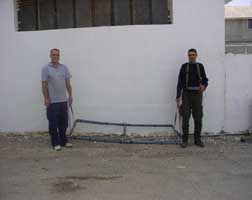
EBINGER UPEX 740M DETECTOR (LARGE LOOP)


Within the Lebanese theatre this detector has primarily been used to detect sub munitions. It has proved versatile as it can be adapted from the 2 metre configuration, requiring a minimum of two operators, to a single 1 metre configuration. In addition to the personnel needed to carry and read the signals, a support team is required to mark, record and excavate the signals.
As with all theatre operations the Large Loop detector was subjected to Quality Control checks and during these the detection/clearance rate proved to be very impressive and consistent.

For more information on the Ebinger UPEX 740M visit www.ebingergmbh.com

 
BALLISTIC APRON


Essentially the Ballistic Apron is a compromise between wearing no body armour, and wearing a full Ballistic Suit. The first option would be unfeasible and intrinsically unsafe, and the latter uncomfortable and impractical. Therefore the option illustrated above allows for protection to the torso, abdominal area and the thigh area, but to the front of the body only. Little protection is offered to the deminer to the sides or back of the body. This equipment is a compromise situation; meeting the minimum standards and retaining flexibility and ease of movement. The de-miner is given protection from the proposed threat while still allowing flexibility and a degree of air circulation which is important in this theatre where temperatures in summer can reach the early 40’s.
In addition, wearing the Apron for periods of time is considerably easier, and more comfortable than if a fuller Ballistic Suit were to be worn.
Ideally the Apron option also allows the operator to function in standing, kneeling and prone modes, which adds to the operator’s comfort and effectiveness.


Within the Aprons design, additional padding is incorporated into the shoulders and upper back area. This is to offer some protection to the operator, particularly to the upper back, when in a prone posture. This additional padding also assists in easing the strain and physical pressure exerted on the deminer from the weight of the Kevlar protection within the front of the Apron.


BALLISTIC VISOR / GOGGLES


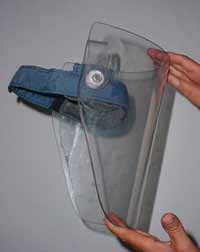
The visor models shown are both worn extensively in theatre, and although there are one or two modifications in design from agency to agency essentially the cranial protection model (right) and the full face model (left) are pretty standard throughout Lebanon and in de-mining generally.
The purpose of the visor is obviously to protect the wearer (de-miner) from suffering facial and cranial damage immediately following the accidental detonation of a UXO or mine. The visor issued should be of such a design and standard as to satisfy the in-country safety standard as gazetted by the MACC SL or the National Demining Office (NDO) authority. Weight and comfort are aspects to be considered, as is the ballistic strength and durability of the actual visor itself. In the de-mining role the de-miners head, neck and throat can be less than a metre from the mine while prodding, for instance. Therefore the full face visor and the cranial visor offer a more consistent and reliable form of protection for the de-miner as the base of the visor butts against the neck collar and chest of the apron. The visor must be able to protect the wearer from the mine debris, but also from the implement being used coming back on him/her, as well as from stones and dirt that will also be thrown up at the de-miner at velocity. As a result of continual modifications and improvements to the visor very few accidents have been recorded where the visor has failed. Improvements however are a continual process, as with all demining safety equipment.


KEVLAR GLOVES


  Kevlar gloves are worn to provide some minor protection to the deminer’s hands in the event of an uncontrolled detonation, particularly against burn injuries from any resulting blast. Within the OES project they have proven to provide some protection to the deminers hands during several of the demining accidents and assisted in reducing the extent of injury sustained.


KNEE PADDING


  Kneepads provide no ballistic protection to the deminer; however they assist the deminers comfort while in the kneeling or prone position. These positions account for more than 60% of a deminers time in the minefield.

 
  PRODDER  
 

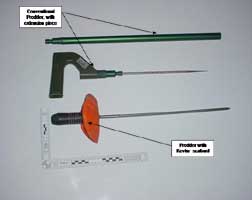
There are probably as many different models of prodder as there are de-mining companies. A prodder is a sharpened metal rod, which the de-miner inserts, under controlled pressure into the ground to “feel” for mines. After a training period and with practical experience a de-miner is able to differentiate between the various substances a mine body can be made from; plastic, metal, wood and naturally occurring materials such as rock. Although the de-miner can’t or doesn’t actually see the item the prodding skills he/she develops will assist greatly in reducing the risk element involved in manual de-mining. As this process is one of the few times that the deminer will actually physically touch the item good drills and discipline are essential, and will be monitored closely during the external QA process.


  TROWEL

 
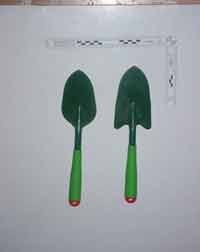
  As with much of the deminers tool kit the trowel has been taken from the horticultural world into the world of humanitarian demining. Although a simple piece of equipment quite a few injuries have occurred to the de-miner from the trowel following an accident. In some previous accidents the deminers hands were afforded considerable protection by the contractor enforcing a policy of wearing Kevlar gloves. Unfortunately, however in one accident where the deminer was using a trowel when the accidental detonation occurred, the ‘blunt force’ trauma to the hand tendons caused by the “square shoulders” of the trowel was more damaging than other injuries resulting from the detonation. To prevent this sort of injury reoccurring, or at least to minimise the damage from any future trowel injury, the organisation remodelled the trowel by simply “rounding” off the trowels shoulders. This doesn’t affect the trowels effectiveness or strength but does reduce the risk of injury if a detonation should occur again in the future, whilst using this piece of equipment.


Right hand trowel before modification
Left hand trowel after modification to help reduce injury


  OTHER DEMINERS “TOOLS”  
 
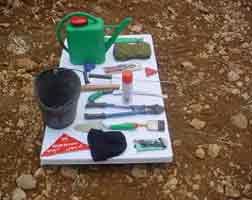
These include a tool bag containing pliers and various vegetation cutting tools, and a bucket and watering can. As stated above many of these items are standard trade and gardening tools.


<<TOP>>


Copyright ©2004 MACC SL - All Rights Reserved