Clearance
Organisations
The following organisations have been involved
with the Operation Emirates Solidarity (OES) project.
MineTech International Limited and BACTEC International Limited
have been contracted directly by the UAE to undertake clearance
of booby traps and mines for OES, while Mines Advisory Group assisted
the project through a UN funded survey of part of the project
area. The LAF Team assist the project by conducting General and
Technical Surveys of reported suspect and dangerous areas, and
the disposal of Unexploded Ordnance.
MineTech International
MineTech International, a UK registered company and division of
Exploration Logistics Group plc, were one of the two commercial
mine action companies contracted to undertake Phase 2 clearance,
by the UAE.
MineTech deployed with all their personnel and
equipment into South Lebanon on 1 May 2002, and following both
accreditation of the company and their assets commenced demining
operations on 6 May.
The geographical areas they were allocated by
the UAE contract were the OES 3 and OES 4 sectors. Refer Map.
The two sectors contained 171 minefields, 17 booby traps and covered
an area of some 245 square kilometres.
At the height of operations MineTech had the
following assets deployed:
10 x 10 man Manual Demining teams
2 x Survey/EOD Teams
2 x Mechanical Support Teams
10 x Mine Detection Dog Teams
1 x ARMTRAC 325 Flail
1 x ARMTRAC 100 Flail
A total of 133 minefields were cleared and 18
booby traps located and destroyed by MineTech in these two areas.
They completed their contractual obligations on 29 August 2003
and departed Lebanon on 31 August 2003.
Refer Statistics
to for MineTech’s Phase 2 clearance details.
For further details about MineTech work in Lebanon
and other countries visit www.minetech.co.uk
BACTEC International Limited
BACTEC is a UK based company specialising in Explosive Ordnance
Survey Clearance & Disposal (EOD), and the clearance of landmines.
BACTEC International Limited was contracted by the UAE to undertake
Phase 1 of the OES project; the clearance of a known 288 booby
traps in the OES 1 sector, and to conduct mine clearance in Phase
2 of the project.
Phase 1 operations commenced on 19 November
2001, and Phase 2 on 13 May 2002.
BACTEC were assigned the OES 1 and OES 2 sectors. Refer Map. The
area believed to contain 85 minefields and 81 booby traps, within
a contaminated area of 247 square kilometres.
During the Phase 2 clearance; the height of
operations, BACTEC had the following assets on the ground.
8 x 10 man Manual Demining Teams (including support for 6 mechanical assets)
1 x Battle Area Clearance Team
1 x General Survey Team
1 x Technical Survey Team
7 x Mine Detection Dog Teams

4 x BOZENA 3 Mini Flails
1 x ARMTRAC 100 Flail
1 x Armoured Bulldozer
On conclusion of this contract BACTEC had cleared
a total of 90 minefields and 46 booby traps, in addition to the
booby traps of Phase 1. BACTEC completed their obligations under
the first contract on 11 May 2002, and the Phase 2 contract on
20 September 2003.
Refer Phase
2 Statistics for details of BACTEC’s Phase 2 clearance
BACTEC were additionally, during the final stages
of the Phase 2 clearance, awarded the sole contract for the Phase
3 area (OES 5). Refer Map.
Work commenced on the ground in this area on 24 June 2003 and
operations completed on 24 November 2003. A total of 75 targets
were identified for completion in the area.
Refer Phase
3 Statistics for details of BACTEC’s Phase 3 clearance
Following the completion of Phase 3 BACTEC then
continued with the survey and clearance of additional tasks identified
in the Phase 2 and Phase 3 areas. The Survey Teams were headed
by a mixture of BACTEC and MACC SL Operations staff assisted by
BACTEC medics. These additional areas were reported by the communities
through the MACC SL Community Liaison team throughout the operations
of Phase 2 and Phase 3.
The subsequent Technical Survey and clearance of these confirmed
dangerous areas was considered an extension to Phase 3 and dubbed
the “Sweep Through” Phase. BACTEC commenced work on
these targets on 19 January 2004 and intends to complete all targets
in their current contract period up to 31 May 2004.
Refer Sweep Through Statistics for details of BACTEC’s clearance
progress in the Sweep Through phase
For more information about BACTEC International
Limited visit www.bactec.co.uk
Mines Advisory Group
Mines Advisory Group (MAG), is a British non-governmental
mine action organisation based in Manchester, England.
MAG has assisted the Operation Emirates Solidarity
project by conducting a General and Technical Survey of identified
targets in the Marjayoun area.
MAG was contracted by UNOPS for the period from 12 January 2003
to 31 August 2003 to provide two survey teams. Each was supervised
by an international Survey Team Supervisor. The teams were assisted
as necessary by the MACC SL Community Liaison Team.
This contribution from MAG effectively verified the target areas
in Marjayoun which subsequently became the basis of the Phase
3 contract.
For details on MAG’s survey findings see Statistics
For more information about MAG’s work
visit www.mag.org.uk
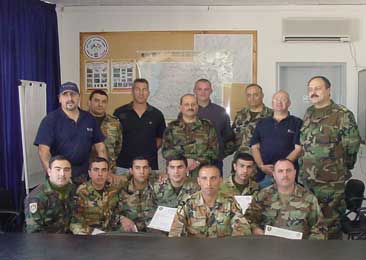
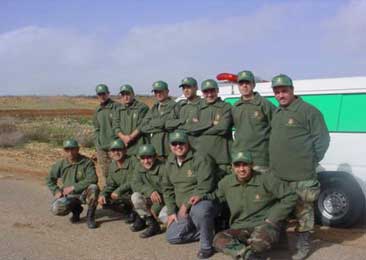
Lebanese Armed Forces (LAF) Technical
Survey/Sampling/EOD Team
A team of 10 LAF soldiers initially became involved
in the Operation Emirates Solidarity (OES) project as a Sampling
asset. The team comprising one Staff Sergeant, one Corporal, eight
sappers, a Medic and a Driver were military trained deminers,
with field experience, before they were selected by the LAF to
join the Sampling Team.
As mentioned in Sampling
there was a need for this external Quality Assurance process on
sites where only one asset had been deployed during clearance
operations, or where a particular problem had occurred that warranted
a more detailed investigation.
The team undertook a month long training course led by an Officer
from the MACC SL QA section. After their successful accreditation
on 29 May 2003, they were deployed operationally within the OES
project area. Initially they deployed with a QA Officer who assisted
them with the paperwork that was required to be completed.
As additional suspect areas came to the attention
of the MACC SL through community liaison with residents in the
former occupied areas, the need for the MACC SL to have its own
survey asset became apparent, particularly following the end of
MAG’s survey contract with OES in August 2003. It was decided
that as sampling was not conducted on every site, there was capacity
within the LAF Sampling Team workload for them to assume the additional
role of Technical Survey Team. The team, already familiar with
the requirements of the MACC SL, and the project were the obvious
and most cost effective choice to take this role.
Once again the team undertook a training course
in the techniques of General and Technical Survey, and Explosive
Ordnance Disposal. The course conducted over a three week period
and run by a QA Officer from MACC SL covered all aspects of survey
work including the role of the Community Liaison team and how
they support the process.
Emphasis was placed on the need for accuracy both on the ground,
and in reporting as well as safety.
|